Codon Wheel Explained: How This Genetic Tool Decodes Life’s Blueprint

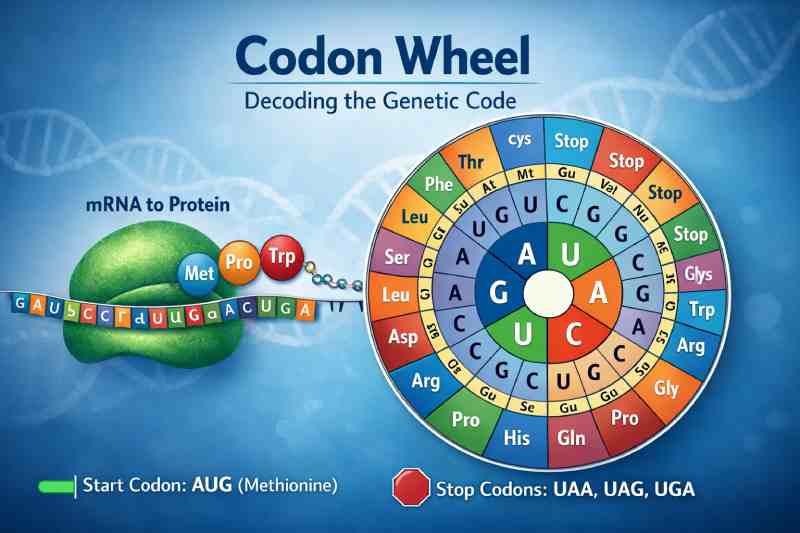
The codon wheel is one of the most practical and visually intuitive tools in molecular biology. If you have ever wondered how a simple sequence of letters like A, U, G, and C can determine the structure of proteins inside every living cell, the codon wheel is the diagram that makes it all click. It translates the language of RNA into the language of amino acids, bridging genetics and protein synthesis in a single circular chart.
Table of Contents
ToggleWhat Is a Codon Wheel?
A codon wheel is a circular diagram that shows how three-letter RNA sequences, known as codons, correspond to specific amino acids or stop signals during protein synthesis. Each codon consists of three nucleotide bases chosen from adenine (A), uracil (U), cytosine (C), and guanine (G).
Because there are four possible bases and each codon contains three positions, there are 4 × 4 × 4, or 64 possible codon combinations. These 64 combinations encode 20 amino acids and three stop signals. The codon wheel organizes these combinations in a layered circle so that users can move from the center outward to determine which amino acid a codon represents.
Instead of scanning a long table, you simply start at the center of the wheel with the first base, move to the second ring for the second base, and finish at the outer ring for the third base. The outermost section reveals the corresponding amino acid or stop instruction.
The Structure of the Codon Wheel
The Three Layers
The codon wheel is divided into three main concentric layers:
-
Inner circle: First nucleotide of the codon
-
Middle circle: Second nucleotide
-
Outer circle: Third nucleotide and resulting amino acid
You always read the codon from the center outward. This structure mirrors the way codons are read in mRNA, from the 5’ to 3’ direction.
For example, if you want to decode the codon AUG:
-
Start at the center with A
-
Move outward to U in the second ring
-
Move to G in the third ring
You will land on methionine, which is also the start codon that signals the beginning of protein synthesis.
Color Coding and Organization
Many versions of the codon wheel use color coding to group similar amino acids or to distinguish stop codons clearly. This design makes it easier for students to identify patterns, such as which codons code for the same amino acid.
For instance, leucine is encoded by six different codons. On the wheel, these codons are often grouped closely together, visually reinforcing the concept of redundancy in the genetic code.
Why the Codon Wheel Matters in Biology
The codon wheel is not just a teaching aid. It reflects one of the most fundamental principles of life: the genetic code.
Translating Genetic Information
DNA contains the blueprint for building proteins, but proteins are assembled in the cytoplasm by ribosomes using mRNA as a template. During transcription, DNA is converted into mRNA. During translation, ribosomes read mRNA three bases at a time. Each set of three bases is a codon.
This is where the codon wheel becomes essential. It allows you to determine which amino acid corresponds to each codon in the mRNA sequence. By stringing together the amino acids in the correct order, the cell builds a functional protein.
Understanding Mutations
The codon wheel is also useful for analyzing genetic mutations. If one nucleotide changes in a codon, the resulting amino acid may change as well. By comparing the original and mutated codons on the wheel, you can determine whether the mutation is:
-
Silent (no change in amino acid)
-
Missense (change to a different amino acid)
-
Nonsense (change to a stop codon)
This makes the codon wheel an important tool in genetics, medicine, and biotechnology.
The Genetic Code and Its Redundancy
One striking feature revealed by the codon wheel is redundancy. Although there are 64 possible codons, there are only 20 amino acids. This means that most amino acids are encoded by more than one codon.
Degeneracy of the Genetic Code
This redundancy is called degeneracy. For example:
-
Glycine is encoded by GGU, GGC, GGA, and GGG.
-
Phenylalanine is encoded by UUU and UUC.
When you look at these codons on the codon wheel, you will notice that many differ only in the third position. This “wobble” position often allows variation without changing the amino acid.
This feature provides a protective effect against mutations. If a mutation occurs in the third base, it may not alter the amino acid at all, reducing the likelihood of harmful protein changes.
How to Read a Codon Wheel Step by Step
Using the codon wheel is straightforward once you understand the logic.
Step 1: Identify the Codon
Make sure you are working with mRNA, not DNA. In mRNA, thymine (T) is replaced by uracil (U). If you are given a DNA sequence, you must first transcribe it into mRNA.
Step 2: Start at the Center
Find the first nucleotide of the codon in the center circle.
Step 3: Move Outward
Locate the second nucleotide in the next ring, staying within the segment defined by the first base.
Step 4: Finish at the Outer Ring
Find the third nucleotide in the outer ring. The amino acid listed in that segment is the one encoded by the codon.
For example, the codon UGA:
-
Start with U in the center
-
Move to G in the second ring
-
Move to A in the outer ring
You will find that UGA is a stop codon, signaling the end of translation.
The codon wheel makes this process visual and intuitive, reducing errors when decoding long sequences.
Start and Stop Codons
The codon wheel clearly highlights special codons that control the beginning and end of protein synthesis.
Start Codon
AUG codes for methionine and serves as the universal start codon in most organisms. When a ribosome encounters AUG, it begins translating the mRNA into a protein.
Stop Codons
There are three stop codons:
-
UAA
-
UAG
-
UGA
These codons do not code for amino acids. Instead, they signal the ribosome to stop translation and release the completed protein.
Seeing these codons on the codon wheel helps students understand how protein length is determined.
Applications in Biotechnology and Medicine
The codon wheel is widely used in applied science fields beyond basic biology classes.
Genetic Engineering
In genetic engineering, scientists often design synthetic genes. They use the codon wheel to select codons that match the host organism’s preferences, a concept known as codon optimization. Even though multiple codons encode the same amino acid, certain organisms prefer specific codons for efficient protein production.
Disease Research
In medical genetics, researchers analyze mutations at the codon level. By mapping altered codons on the codon wheel, they can determine whether a mutation changes an amino acid or creates a premature stop codon. This insight helps explain inherited disorders and guides the development of targeted therapies.
Vaccine and Drug Development
During vaccine design, scientists may modify viral genes to ensure they produce stable proteins. The codon wheel assists in verifying that changes in nucleotide sequence still produce the intended amino acid sequence.
Codon Wheel vs. Codon Table
While both tools display the genetic code, they differ in format.
A codon table is arranged in rows and columns, typically with the first base on the left, the second base across the top, and the third base within each box. Some people prefer the structured layout of a table.
However, many students find the codon wheel easier to use because it visually mimics the step-by-step reading process of translation. The circular design naturally guides the eye from the first base to the third.
The codon wheel also reinforces the concept that the genetic code is systematic and organized rather than random.
Common Mistakes When Using a Codon Wheel
Even though the codon wheel is simple, beginners often make predictable errors.
Confusing DNA with RNA
Remember that the codon wheel is based on mRNA. If you see a T in your sequence, you must convert it to U before decoding.
Reading from the Outside In
The codon wheel must be read from the center outward. Starting at the outer ring will lead to incorrect results.
Ignoring Reading Frames
Codons are read in groups of three starting from a specific position. Shifting the reading frame by one base changes every codon downstream. The codon wheel cannot correct frame errors; you must identify the correct starting point first.
Educational Importance in the United States
Across American high schools and universities, the codon wheel is a staple of biology instruction. It appears in Advanced Placement Biology courses, college genetics classes, and standardized exam preparation materials.
Students are often required to:
-
Transcribe DNA to mRNA
-
Translate mRNA into amino acid sequences
-
Identify mutations and predict their effects
The codon wheel simplifies all these tasks. Its continued use in classrooms demonstrates its effectiveness as a teaching tool.
The Universality of the Genetic Code
One remarkable fact highlighted by the codon wheel is that the genetic code is nearly universal. From bacteria to humans, most organisms use the same codon-to-amino-acid assignments.
This universality supports the theory of common ancestry and allows scientists to transfer genes between species in biotechnology applications. For example, a human gene inserted into bacteria can still be translated correctly because the codon assignments are largely the same.
The codon wheel visually represents this shared biological language.
Conclusion
The codon wheel is more than a classroom diagram. It is a visual representation of one of biology’s most fundamental principles: the translation of genetic information into functional proteins. By organizing the 64 codons into an intuitive circular format, the codon wheel makes it easy to decode mRNA sequences, analyze mutations, and understand the redundancy and universality of the genetic code.