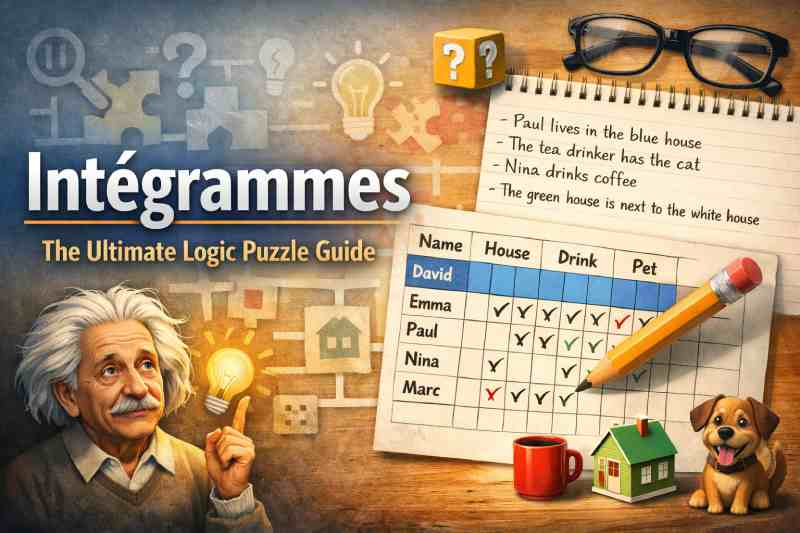
Intégrammes are one of the most satisfying forms of logic puzzles ever created. Built on structured reasoning rather than guesswork, these grid-based challenges push you to connect clues, eliminate impossibilities, and uncover a single correct solution. While the term is French in origin, the puzzle format itself is widely loved across the United States under names like logic grid puzzles or deduction puzzles.
What Are Intégrammes?
At their core, intégrammes are structured logic puzzles that require deductive reasoning. Instead of relying on vocabulary like crossword puzzles or speed like word searches, they demand analytical thinking.
A typical puzzle presents:
- Several categories (for example: names, cities, pets, professions)
- An equal number of items in each category
- A series of written clues
- A blank grid for recording deductions
Your task is to determine how each item in one category connects to items in the others. Every clue narrows the possibilities until only one logical arrangement remains.
The defining feature of intégrammes is that guessing rarely works. Each answer must be derived through logical elimination.
The Structure Behind the Puzzle
To understand why these puzzles are so engaging, it helps to look at how they are constructed.
Categories and Variables
Most puzzles contain three to five categories. For example:
- Four friends
- Four favorite drinks
- Four vacation destinations
Each friend is matched with one drink and one destination. No overlaps. No duplicates.
The Grid System
The grid is the heart of the puzzle. It allows you to compare every item against the others. You mark:
- A check mark when a match is confirmed
- An X when a match is impossible
Over time, patterns emerge.
The Clues
Clues are written as statements, such as:
- The person who drinks coffee did not travel to Florida.
- Sarah visited California.
- The tea drinker traveled east of the Mississippi River.
Some clues are direct. Others are indirect and require interpretation. This layered deduction is what makes intégrammes deeply rewarding.
Why Intégrammes Are So Mentally Powerful
There’s a reason teachers, cognitive trainers, and puzzle enthusiasts recommend this type of mental exercise.
They Strengthen Logical Thinking
Each clue must be analyzed carefully. You learn to:
- Break down complex information
- Identify relationships
- Eliminate contradictions
This strengthens your reasoning skills in everyday decision-making.
They Improve Focus and Patience
Unlike fast-paced games, these puzzles require steady concentration. You can’t skim. You must process each clue thoughtfully.
They Reward Deep Satisfaction
When the final piece clicks into place, the sense of completion is powerful. The brain recognizes the consistency and closure of the solution.
That “aha” moment keeps people coming back to intégrammes again and again.
A Classic Example: The Einstein Riddle
One of the most famous logic puzzles in the world is often associated with Albert Einstein. It involves five houses, five residents, five pets, and multiple clues. The challenge is to determine who owns a specific animal.
Although historians debate whether Einstein actually created it, the puzzle perfectly illustrates the structure used in intégrammes. It combines direct statements with relational clues like “next to” or “immediately left of,” requiring layered deduction.
This style of puzzle demonstrates how complex reasoning can unfold step by step through logical elimination.
Intégrammes in the United States
While the French term may not be widely recognized in American puzzle magazines, the format is extremely popular.
In the United States, you’ll often see them labeled as:
- Logic grid puzzles
- Deduction puzzles
- Zebra puzzles
They appear in:
- Puzzle books
- Brain teaser collections
- Classroom worksheets
- Printable PDF challenges
Even though the terminology differs, the structure remains the same. The popularity of this format proves that the appeal of structured deduction crosses cultural boundaries.
How to Solve Intégrammes Effectively
If you’re new to this type of puzzle, follow a structured approach.
Step 1: Read All the Clues First
Before marking anything, understand the scope of the problem. Identify how many categories and variables you’re working with.
Step 2: Start With Direct Clues
Statements like “Emily owns the dog” are gold. They immediately lock in one match and eliminate several others.
Step 3: Mark Eliminations Clearly
If Mark owns the dog, he cannot own the cat, bird, or fish. Mark those as impossible immediately.
Step 4: Use Indirect Reasoning
Some clues connect items across categories. For example:
“The person who drinks tea lives next to the person who owns the cat.”
This requires spatial reasoning or positional deduction.
Step 5: Revisit Clues Often
As the grid fills in, earlier clues may reveal new implications. Strong solvers constantly re-check the puzzle.
The key to mastering intégrammes is discipline. Never guess. Always deduce.
Common Mistakes Beginners Make
Even smart problem-solvers can stumble. Here are the most frequent errors:
Ignoring Negative Clues
A clue like “Jason does not own the bird” is just as important as a positive statement.
Forgetting One-to-One Matching
Each item pairs only once. No duplicates. If something is confirmed elsewhere, it cannot appear again.
Skipping Logical Steps
Sometimes the answer feels obvious, but skipping the reasoning can cause confusion later.
Not Keeping the Grid Clean
Messy markings lead to mistakes. Clear organization is essential.
Avoiding these pitfalls dramatically improves your solving speed.
Educational Benefits of Intégrammes
These puzzles are more than entertainment. They are powerful cognitive tools.
In Classrooms
Teachers use them to:
- Teach structured reasoning
- Develop reading comprehension
- Encourage analytical thinking
Students must interpret written clues carefully, strengthening language processing alongside logic.
In Cognitive Training
Adults use these puzzles to maintain mental sharpness. Regularly solving logic challenges helps:
- Improve memory
- Strengthen concentration
- Enhance problem-solving speed
Because intégrammes require active engagement, they are far more stimulating than passive entertainment.
Digital vs. Paper Versions
Traditionally, these puzzles were solved on paper. Today, many digital apps offer interactive versions.
Advantages of Digital Platforms
- Automatic marking
- Timer tracking
- Hint systems
- Adjustable difficulty
Why Paper Still Wins for Many
Paper forces you to think independently. There’s no auto-correction. Many enthusiasts feel that solving on paper creates deeper engagement.
Regardless of format, the core reasoning process remains unchanged.
Difficulty Levels Explained
Not all puzzles are equal.
Beginner Level
- 3 categories
- 3 variables each
- Mostly direct clues
These are ideal for newcomers.
Intermediate Level
- 4 categories
- 4–5 variables
- Combination of direct and indirect clues
These require layered thinking.
Advanced Level
- 5 or more categories
- Positional logic
- Multi-step deduction chains
These can take an hour or more to complete.
The beauty of intégrammes is that they scale with skill level.
Why They Remain Popular
In a world filled with fast scrolling and short attention spans, these puzzles offer something different.
They require slow thinking. They demand attention. They reward patience.
Instead of reacting instantly, you analyze carefully.
That mental shift is refreshing.
It’s no surprise that intégrammes continue to appear in magazines, classrooms, and puzzle collections year after year.
(FAQs)
Are intégrammes good for improving critical thinking?
Yes. They require structured reasoning, elimination of contradictions, and careful interpretation of clues, which strengthens critical thinking skills.
How long does it take to solve an average puzzle?
A beginner-level challenge may take 10–20 minutes, while advanced ones can take an hour or more.
Are intégrammes suitable for children?
Yes, simplified versions are often used in middle school classrooms to build reasoning skills.
Do you need advanced math skills to solve them?
No. These puzzles rely on logic, not mathematics. Basic reading comprehension and reasoning are sufficient.
Where can I practice regularly?
They are available in puzzle books, educational materials, and various print or digital formats designed for logic enthusiasts.
Conclusion
Intégrammes stand as one of the most intellectually satisfying puzzle formats ever developed. Built on structured deduction rather than guesswork, they challenge the brain in a way few games can. By analyzing clues, marking eliminations, and following logical chains, solvers experience a deep sense of clarity when the final solution emerges.
Whether you encounter them in a classroom, a puzzle book, or a digital format, these logic challenges remain timeless. Their ability to sharpen reasoning, improve focus, and provide meaningful mental stimulation ensures they will continue captivating puzzle lovers for generations.